Why an e-shop needs live chat
Customers decide now. If they don't know whether a part fits their mower or when the parcel will arrive, an email reply in six hours won't help. The phone works only during business hours. Live chat is the only channel that answers the moment the question comes up.
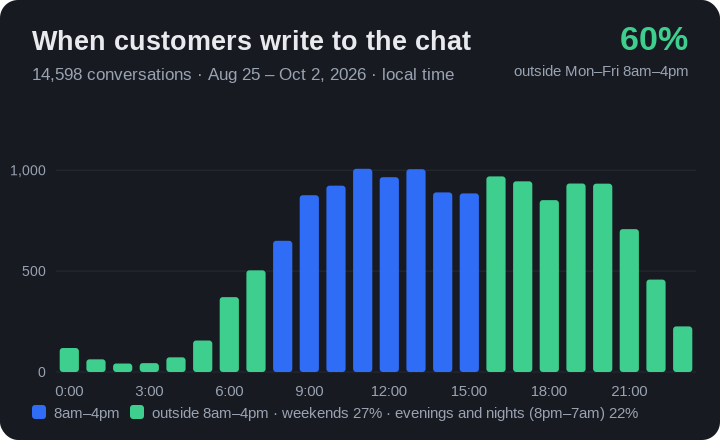
And that moment is often outside business hours. At the spare-parts e-shop where our AI assistant runs, 60% of conversations came outside Monday to Friday, 8am–4pm: 27% at weekends and 22% in the evening or at night. Without a chat, those questions would wait until morning, or the customer would buy elsewhere in the meantime.
Three types of live chat
| Type | When it answers | What it handles | Weakness |
|---|---|---|---|
| Human agent | During business hours | Everything, including exceptions and complaints | Capacity and cost; nobody covers evenings and weekends |
| Scripted chatbot | 24/7 | Repeated questions with a fixed answer | Knows nothing about stock or orders; answers an unexpected question with "I don't understand" |
| AI assistant connected to data | 24/7 | Product choice, stock, orders, shipping, invoices | Needs the e-shop's API; has to hand exceptions over to people |
A generic AI chat without a data connection is left out of the table on purpose. Asked "do you have this in stock?", it answers confidently and wrongly, because it can't see your stock.
What e-shop customers ask in the chat
Most people guess that customers mainly ask about orders. Live data from five countries says otherwise: the assistant used part search in 34–58% of conversations, order status questions made up 3–5% and invoices less than one percent. People mainly want advice on what to buy.
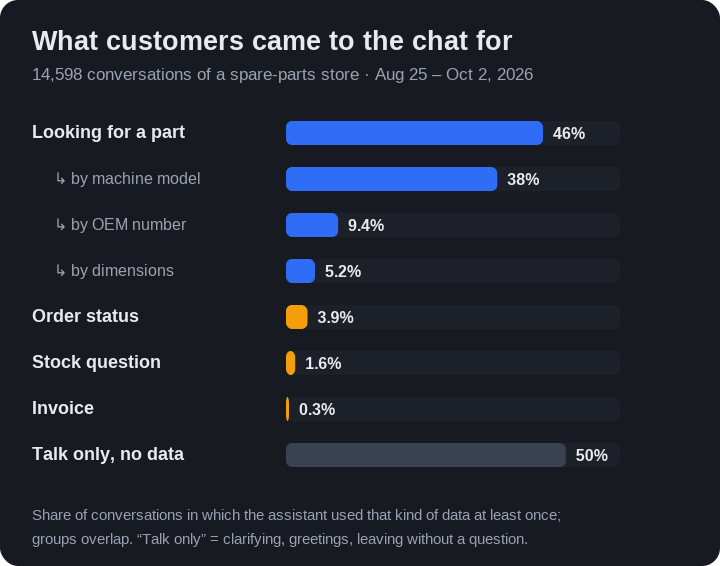
For choosing a live chat, that gives a simple rule: a chat that doesn't know your catalog solves only a minority of questions. An agent knows the catalog, but only during business hours. A scripted chatbot doesn't know it at all. An AI assistant knows it if it's connected to the data.
How much live chat costs
With an agent, you pay for time. If handling a question takes four minutes, 374 conversations a day (that's how many our first client has) means about 25 hours of work every day, weekends included. With a scripted chatbot, you pay mainly for the time it takes to write and maintain the scripts. With an AI assistant, you pay for the plan and the language model usage; at our first client that comes to $0.042 (about €0.04) per conversation. Our assistant's prices are on the pricing page.
How to choose live chat for an e-shop: eight questions
- Does the chat know your range and stock? Does it show a specific product with price and availability, or just point to the search box?
- Can it tell order status safely? Does it verify the customer, for example with the order number and email?
- Does it answer in the evening and at weekends? Check your data to see when questions come in.
- Does it speak your customers' languages and keep your store's currency?
- What does it do when it doesn't know? Does it admit it and point the customer to your team, or make things up?
- What do you learn from it? Can you see what people ask about and what they wanted and didn't find?
- How much does one conversation cost, and can you set a spending cap?
- Where is the data stored, and how does the chat handle customers' personal data?
The best combination: AI first, people for exceptions
For most e-shops a combination works best. The AI assistant answers 24/7 about product choice, availability, shipping, payments and order status. People handle returns, complaints and anything that involves decisions about money or exceptions. In those cases the assistant tells the customer how to reach your team, and the team has more time for the cases where a person is truly needed.
The case study from five countries shows what such an assistant looks like in practice. What exactly it can do is on the AI chatbot for e-commerce page.